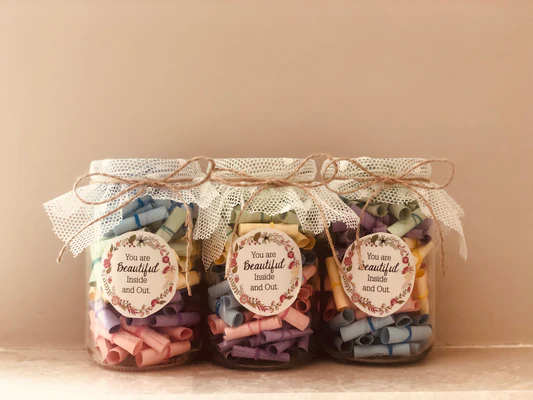
The happiness jar activity for seniors is one of the simplest things you can make with a group of residents, and one of the most useful. A happiness jar is a glass jar filled with little rolled or folded notes: kind words, favourite sayings, happy moments and small things to be grateful for. Pull one out at morning tea, read it aloud, and you have an easy, gentle start to a conversation.
It works as a seated craft session, a one-to-one visit or an ongoing part of your lifestyle program. Below you will find the materials, the four simple steps, a free printable sheet of affirmations and quotes, and my practical tips for running it in aged care, including dementia-friendly adaptations.
Time: 30–45 minutes to make, then a few minutes each day to use
Group size: one-to-one up to about 8 residents per facilitator
Suits: most abilities, including people living with dementia, with the adaptations below
Cost: low (a recycled jar, paper and the free printable)
What You Need for a Happiness Jar
- A clean glass jar with a lid (a recycled jam or pasta sauce jar is perfect; use a plastic jar if glass is a worry in your setting)
- Coloured or patterned paper, or sticky notes
- Scissors (plus a pair of easy-grip or spring-loaded scissors if you have them)
- Pens or thick felt-tip markers
- Decorations: ribbon, stickers, washi tape, fabric scraps or lace
- Our free printable affirmations and quotes (download link at the bottom of this page)

How to Make a Happiness Jar: Step by Step
Step 1: Gather the Materials
Choose a clean jar with a lid, free from labels and sticky residue. Any size works, but a medium jar is easy to hold and fills up nicely. For more jar ideas, see our decorating jars craft activity.
Step 2: Prepare the Affirmations
You can write your own notes with the group, or use our printable sheet of affirmations and motivational quotes. If you use the printable, print it on coloured paper, then cut it into individual slips. Pre-cut a few sheets before the session for residents who would rather not use scissors.


Step 3: Fill the Jar
Roll each slip into a small scroll or fold it into a neat square, then pop it into the jar. Rolling is lovely, gentle hand work, and it is easy to tie a scroll with a little ribbon if someone enjoys fiddly jobs.


Step 4: Decorate the Jar
Add a personal touch with a ribbon around the neck, stickers, washi tape or a fabric circle under the lid. Our decoupage flower jar has more decorating ideas. Add a label such as “Our Happiness Jar” in large print so everyone knows what it is.
Here is a short video tutorial showing an inspiration jar being made:
What to Put in Your Happiness Jar
There is no single right way to fill the jar. Mix and match these ideas to suit your residents.
| Type of note | Examples |
|---|---|
| Affirmations | “I am loved.” “Today is a good day.” (see our free printable) |
| Favourite sayings | “Every cloud has a silver lining.” “Many hands make light work.” |
| Happy moments | “Morning tea in the garden with my daughter.” “Hearing the magpies this morning.” |
| Small gratitudes | “A warm cup of tea.” “Clean sheets.” “A phone call from my grandson.” |
| Gentle conversation starters | “What made you smile today?” “What was your favourite treat as a child?” |
Happiness Jar Activity for Seniors: Tips for Aged Care
I have run this activity in lounges, dining rooms and bedrooms. These are the things that make the difference on the floor.
Group or One-to-One?
In a group (4–8 residents is ideal), sit around one table so everyone can see and hear, and make one shared jar or a small jar each. Keep a second staff member or volunteer nearby to help with cutting and writing. One-to-one works beautifully for residents who stay in their rooms or find groups overwhelming. Make a personal jar together over two or three short visits, and let them choose every note.
Dementia-Friendly Adaptations
- Large print: print the affirmations at a bigger size (or enlarge them on the photocopier) with dark text on a light background.
- Picture prompts: pair notes with simple pictures (a cup of tea, a garden, a dog) so residents who no longer read easily can still enjoy them.
- Scribing: if someone cannot write, ask “What would you like me to write for you?” and write their exact words. Read it back to check you have it right.
- Keep choices simple: offer two options (“Blue paper or yellow?”) rather than a whole pile.
- Focus on the doing: rolling, tying ribbon and dropping notes into the jar are lovely activities in themselves, even if the words are not the focus.
Low Vision and Limited Hand Dexterity
- Use thick black felt-tips, bold coloured paper and good lighting near a window.
- Offer pre-cut slips, easy-grip scissors or a paper punch instead of standard scissors.
- Choose a wide-mouthed jar that is easy to reach into, and pop a non-slip mat underneath.
- Fold rather than roll for residents with arthritis or a tremor. It is easier on the fingers.
When a Note Brings Up a Sad or Difficult Memory
Happy words can sometimes bring up grief, especially around anniversaries or after a loss. If a resident becomes teary, slow down, acknowledge it (“That sounds like a very special person”), and give them time. Do not rush to change the subject or cheer them up. Offer a quiet moment, a cup of tea or a walk, and let the care team know so they can follow up. Most of the time, the resident just wants someone to listen.
Involving Families and Staff
- Invite families to add a note to the jar during visits, or post a few slips home with a newsletter.
- Ask staff from every shift to drop in one kind word or happy moment a week. Residents love hearing notes from “their” carers.
- Use the jar at family afternoons as an easy, low-pressure way for visitors to start a conversation.
Keeping the Jar Going
The jar is not a one-off craft. It is most valuable when it becomes part of the daily routine:
- Read one or two notes aloud at morning or afternoon tea.
- Keep a jar per wing or household so each group has its own.
- Add notes after outings, birthdays and celebrations to capture happy moments as they happen.
- Refresh the printable slips every few months so the notes do not get stale.
Materials, Timing and Group Size
| What | Suggestion |
|---|---|
| Session length | 30–45 minutes to make; 5–10 minutes a day to use |
| Group size | 1–8 residents per facilitator, plus a helper for larger groups |
| Jars | One shared jar, or a small jar per resident to keep in their room |
| Paper | About 10–15 slips per resident; pre-cut extras |
| Best time | Mid-morning or after afternoon tea, when energy is good |
If the Room Goes Quiet
Silence is fine, so give people a moment. Then try reading a note yourself and sharing a short story of your own (“My nan always said that”). Ask an easy yes/no question, pass the jar around so people can hold it, or switch to a familiar old saying and let the group finish it. Some residents simply enjoy the calm of rolling paper, and that is a good session too.
More Activities You Might Like
- Gratitude Tree Activity for Seniors
- Calming Sensory Bottle for Seniors
- Memory Boxes Activities for Seniors
- Creative Reminiscing Activities for Seniors
- Sensory Activities for Dementia Care
- Free Activities for Seniors
For more ideas on choosing meaningful activities for people living with dementia, the Alzheimer’s Association activities guide is a helpful read.
Happiness Jar FAQs
What is a happiness jar?
A happiness jar is a jar filled with small notes such as affirmations, favourite sayings, happy moments and things to be grateful for. You pull out a note whenever you would like a lift or a conversation starter.
Is the happiness jar suitable for people living with dementia?
Yes, with a few adaptations. Use large print and picture prompts, scribe for residents who cannot write, keep choices simple, and focus on the enjoyment of making and sharing rather than the words themselves.
How many residents can join in?
It works one-to-one or in a group. Up to about 8 residents per facilitator is comfortable, with a helper for cutting and writing.
What should we write in the jar?
Affirmations, favourite sayings, happy moments, small gratitudes and gentle questions. Our free printable gives you a ready-made sheet of affirmations and quotes to start with.
How do we keep using the jar?
Read a note or two aloud at morning tea, add new notes after outings and celebrations, and refresh the slips every few months.
Download the Free Happiness Jar Printable
Print our A4 sheet of affirmations and motivational quotes, cut out the slips and you are ready to fill your jar.
Download your printable PDF copy of Happiness Jar Activity for Seniors